
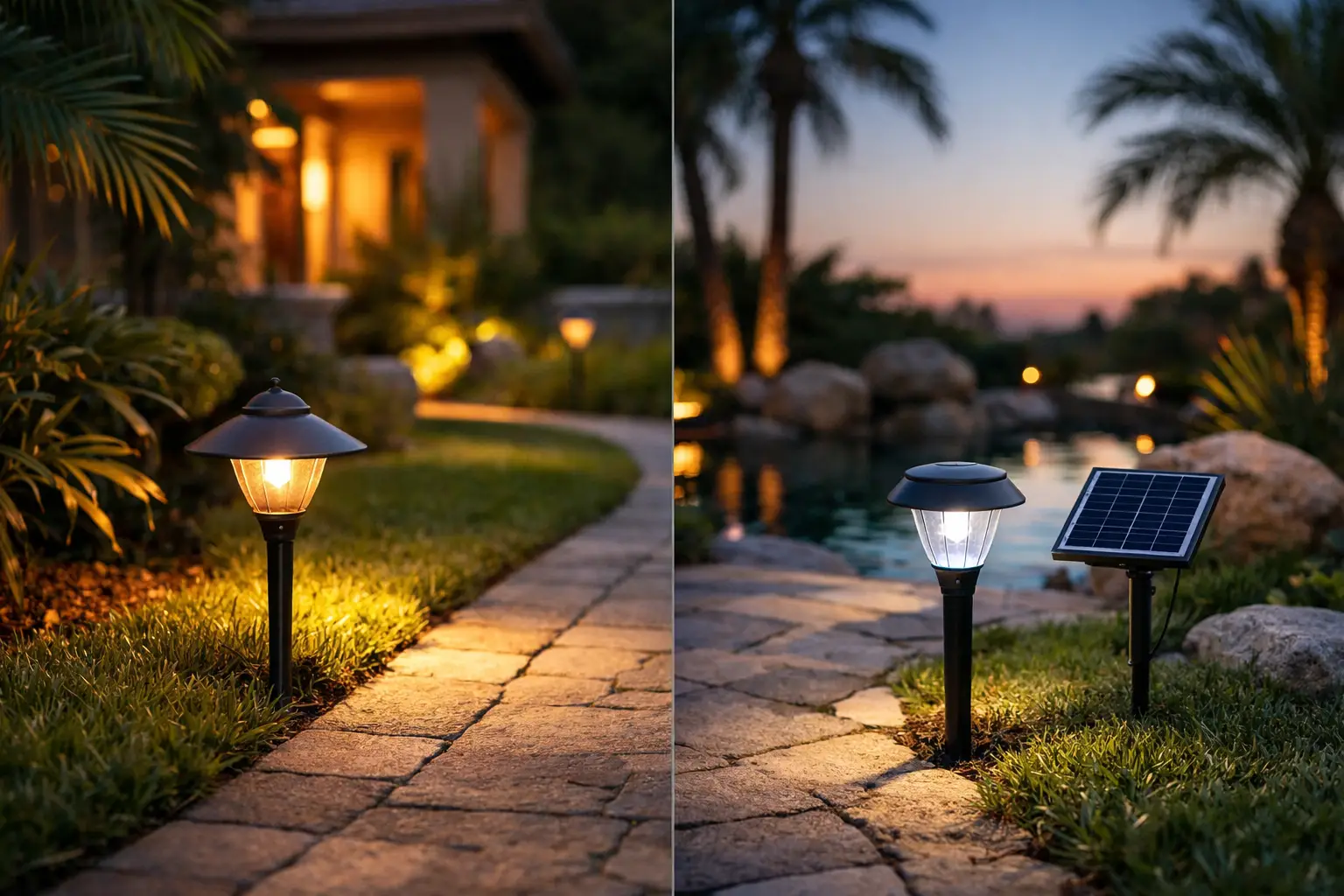
A beautifully lit property should feel intentional long after the sun goes down. When homeowners compare low voltage versus solar lighting, the question is rarely just about how a fixture is powered. It is about whether the front walk feels welcoming, whether a mature oak canopy becomes an asset at night, and whether the pool deck, patio, or dock remains comfortable and safe for entertaining.
Both options have a place outdoors. Yet for Tampa Bay properties where architecture, landscaping, and outdoor living are central to the home, they produce very different results.
Low Voltage Versus Solar Lighting: The Core Difference
Solar fixtures create and store their own energy. A small photovoltaic panel charges an internal battery during daylight, then powers the fixture after dark. Installation is simple because no low-voltage cable or transformer is required.
Low-voltage landscape lighting uses a transformer to reduce standard household current to a safer 12-volt system. Professional-grade cable carries that power to LED fixtures positioned throughout the property. The system is typically controlled by a timer, photocell, or smart control, so the lighting comes on consistently when it is needed.
That difference in power supply shapes nearly every practical decision that follows: brightness, reliability, fixture selection, design flexibility, maintenance, and the overall impression the property makes at night.
Why Solar Lighting Appeals at First
Solar lighting is appealing for understandable reasons. It can be placed quickly, requires no trenching, and usually has a lower upfront cost. For a small garden border, a temporary pathway marker, or a location far from a power source, a quality solar fixture may be a sensible answer.
It also offers a degree of flexibility. A homeowner can move a solar stake light as plantings change, test a location before making a larger investment, or add a modest accent to an area where consistent illumination is not essential.
The limitation is that solar lighting depends on the exact conditions it faces each day. Tampa Bay has abundant sunshine, but landscape lighting is often installed precisely where sunlight is blocked: beneath palms and oaks, near dense hedges, beside covered entries, or around screened pool enclosures. A solar panel that receives partial sun may charge inconsistently, and a cloudy summer afternoon can reduce the hours of useful light that evening.
Even in a sunny location, the small battery and compact solar panel in many consumer fixtures limit output. The result is often a soft glow rather than the defined, controlled illumination needed to light a walkway, reveal stonework, or create a refined architectural effect.
Where Low Voltage Lighting Creates Greater Distinction
Low-voltage LED lighting is designed for properties where the nighttime setting matters as much as the daytime view. It gives a lighting designer control over beam spread, fixture placement, color temperature, brightness, and the relationship between illuminated and shadowed areas.
A carefully designed system can graze a textured exterior wall, reveal the structure of a specimen tree, define a curved walkway without glare, and add depth around a lanai or pool deck. These are not simply brighter versions of solar lights. They are distinct layers of light, composed to guide the eye and make a property feel finished.
Reliability is equally important. With low voltage, fixtures are powered from a dedicated transformer rather than a small battery that must recharge daily. The lighting can operate on a consistent schedule, including during stretches of rain or after a day when tree cover limits direct sunlight. That predictability is particularly valuable for entry paths, steps, gates, pool areas, and entertaining spaces.
Professional systems also support a much wider range of fixture styles. Discreet uplights, path lights, downlights, hardscape lights, deck lights, well lights, and specialty fixtures can be selected to suit the architecture and landscape rather than forcing the design around a single solar stake-light format.
Brightness Is Only Part of the Safety Question
It is tempting to judge outdoor lighting by brightness alone. More light is not always better. A poorly aimed fixture can create glare, wash out attractive textures, cast harsh shadows, and make a space less comfortable.
The better measure is useful illumination. A front walk needs enough even light to make changes in elevation clear. A pool deck needs visibility at its edges without turning the area into a floodlit patio. A driveway may need directional light that helps arrivals and departures while preserving the home’s calm, polished character.
Solar fixtures can provide modest visual markers along a path, provided their charge is strong. Low-voltage systems allow for more dependable light levels and precise aiming, which is why they are generally the stronger choice when safety and wayfinding are primary goals. On larger properties, that consistency also helps ensure that the side yard, rear gate, or transition from patio to lawn does not disappear after sunset.
The Tampa Bay Climate Changes the Equation
Florida’s humidity, heavy rain, heat, salt air near the coast, and seasonal storms are demanding conditions for any exterior fixture. Products intended for occasional use in a mild climate may not perform gracefully through years of wet summers and intense sun.
Solar lighting has two components that commonly require attention: the solar panel and the rechargeable battery. Dirt, pollen, leaf debris, and irrigation residue can reduce charging efficiency. Batteries gradually lose capacity, and when they do, a fixture may illuminate only briefly or fail to come on at all. Replacement may be possible, but lower-cost fixtures are often treated as disposable when one component fails.
A professionally installed low-voltage system also needs quality materials and periodic care, but its components are built for a longer service life. Weatherproof LED fixtures, properly protected connections, durable cable, and an appropriately sized transformer are essential. Maintenance can include cleaning lenses, adjusting fixtures as landscaping grows, checking connections, and replacing a component before it affects the look of the overall system.
For waterfront homes, docks, and exposed outdoor living areas, fixture selection and installation details become even more consequential. The right system should be planned for its environment, not merely placed where there happens to be an open patch of ground.
Upfront Cost Versus Long-Term Value
Solar lighting usually wins the initial price comparison. A homeowner can purchase several fixtures and install them in an afternoon. For a small, low-priority accent, that may be all that is needed.
Low-voltage lighting represents a more considered investment. The cost includes design, professional installation, transformer capacity, cable routing, premium fixtures, and controls. The return is a tailored lighting plan that supports the architecture and landscape as a complete composition, rather than scattering isolated points of light around the yard.
Operating costs remain modest with efficient LED technology. More importantly, a well-designed system continues to create value after installation by extending the use of outdoor spaces, improving curb appeal, and giving the home a distinctive nighttime identity. For homeowners preparing to entertain, sell, or simply enjoy the property more fully, that transformation can be far more meaningful than the difference in initial fixture price.
Which Option Is Right for Your Property?
Solar lighting is a reasonable choice for a simple, supplemental application with full sun and low expectations for brightness or duration. It can be useful for marking a small garden feature, testing an idea, or adding temporary light where running cable is impractical.
Low-voltage lighting is the better fit for a front elevation, landscaped entry, pool enclosure, patio, deck, driveway, mature landscape, or any area where dependable performance and visual refinement matter. It is also the clear choice when lighting must serve a safety function every evening rather than only on the days a battery reaches a full charge.
The decision does not have to be absolute. Some homeowners use a solar accent in a remote garden bed while relying on a professionally designed low-voltage system for the areas guests see and use most. The key is to match the technology to the purpose instead of expecting one modest solar fixture to perform like a complete lighting plan.
A Better Starting Point Than Choosing Fixtures
Before selecting products, look at the property after dark. Notice where the entry loses definition, where steps need clarity, which architectural details deserve attention, and where your family gathers outside. Consider how seasonal growth will affect the view and how the system should perform during summer rains as well as clear winter evenings.
Elegant Accents Outdoor Lighting approaches this process as a custom design conversation, not a fixture sale. A thoughtful plan can balance beauty, security, usability, and budget while leaving room for future additions as the property evolves.
The most memorable outdoor lighting is rarely the brightest. It is the lighting that feels as though it has always belonged there – drawing attention to what makes your home distinctive while quietly making every evening more inviting.