
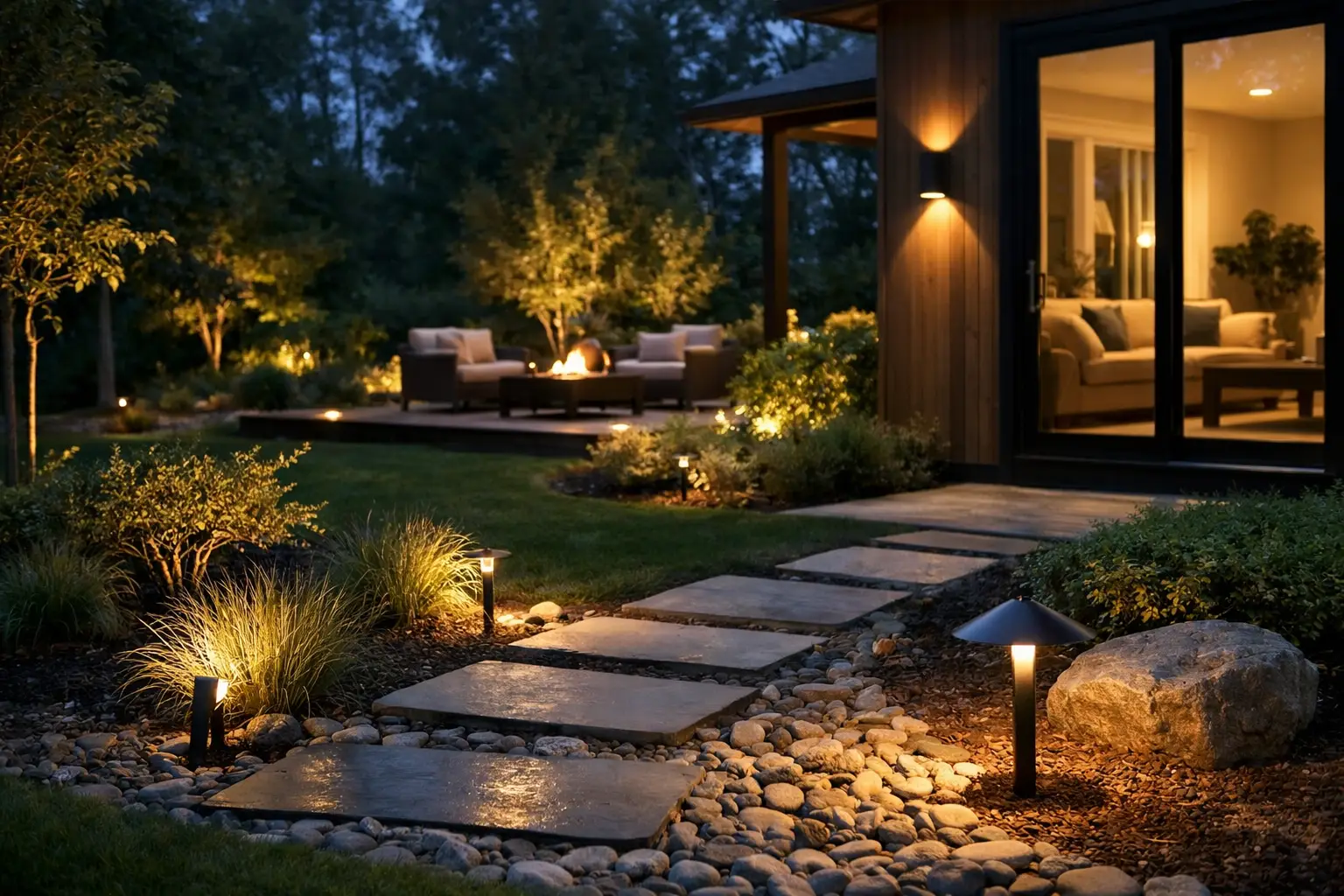
A home can look beautifully finished in daylight, then disappear after sunset. Low voltage lighting changes that experience by giving architecture, landscaping, pathways, pool areas, and outdoor gathering spaces a refined presence well into the evening. For homeowners asking, what is low voltage lighting, the answer begins with a safer, more flexible way to create exceptional outdoor illumination.
Low voltage lighting is not simply about placing a few fixtures around a yard. When thoughtfully designed, it is a layered system that directs attention to the details that make a property distinctive: a textured stone facade, mature palms, a dramatic oak, a welcoming entry, or the edge of a pool deck prepared for entertaining.
What Is Low Voltage Lighting?
Low voltage lighting is an outdoor lighting system that operates at a reduced electrical voltage, most commonly 12 volts. Standard household electrical service is typically 120 volts. A low voltage system uses a transformer to step that power down before it travels through purpose-built landscape wire to the fixtures.
The result is a highly adaptable lighting approach suited to landscape beds, walkways, driveways, patios, lanais, docks, pool cages, and architectural features. Modern LED fixtures are the preferred choice for most professionally installed systems because they provide excellent light quality while using a fraction of the energy required by older halogen lamps.
A complete low voltage lighting system includes a transformer, wire, weatherproof connections, fixtures, LED lamps or integrated LED modules, and controls. Each part matters. A premium fixture cannot perform as intended if the transformer is undersized, the wire run is poorly planned, or the connections are left vulnerable to Florida’s moisture and storms.
Why Low Voltage Is a Natural Choice Outdoors
For an established Tampa Bay property, outdoor lighting needs to do more than turn on. It should enhance the home without creating glare, survive demanding weather, and remain dependable through changing seasons. Low voltage systems are well suited to that work.
The lower operating voltage offers an added measure of safety around gardens, paths, decks, and water-adjacent areas. It also gives designers more freedom to place fixtures precisely where they will have the greatest visual effect. Rather than relying on broad, harsh illumination, low voltage lighting can create controlled pools of light and subtle contrast.
That control is what gives a home its evening character. A soft wash across a stucco wall can reveal scale and texture. Narrow beams can bring height to palms or cypress trees. Shielded path lights can guide guests without shining into windows. The goal is not to make every corner equally bright. It is to create balance, comfort, and a lasting impression.
Energy efficiency is another practical advantage. LED low voltage fixtures use considerably less electricity than traditional outdoor lighting options and generally require less frequent lamp replacement. The exact savings depend on the system size, operating schedule, and existing lighting, but efficient LED technology makes extended evening use far more reasonable for many homeowners.
How a Low Voltage Lighting System Works
The transformer is the system’s control center. It connects to an appropriate electrical source and converts line voltage to low voltage power. From there, landscape wire carries electricity to each fixture location.
A professional design accounts for voltage drop, which is the gradual reduction in voltage that can occur across longer wire runs. If this is ignored, fixtures farther from the transformer may appear dimmer or produce inconsistent color. Proper wire sizing, run layout, load calculations, and transformer selection help every fixture perform as designed.
Controls determine when the system operates. Many properties benefit from a photocell or astronomical timer that turns lights on around dusk and off at a selected time. Smart controls can add scheduling flexibility, while some homeowners prefer a straightforward timer for reliable, uncomplicated operation. The best choice depends on how the property is used and how much control the owner wants.
Fixtures are selected for both their purpose and their appearance. An uplight designed to illuminate a live oak has different beam characteristics than a path light meant to guide guests to the front door. A wall wash fixture, deck light, underwater-rated fixture, and downlight mounted in a tree each serve a distinct role. The finest systems feel composed, not repetitive.
Design Matters More Than Fixture Count
It is easy to assume a larger number of fixtures creates a better result. In reality, too much light can flatten a landscape, create glare, and make a luxury property feel more like a parking area than a private residence.
A custom plan begins with the views that matter most. From the street, lighting may emphasize the entry, roofline, columns, trees, and planting beds that establish curb appeal. From inside the home, it may frame views through windows and glass doors. In the backyard, the focus often shifts to the pool deck, outdoor kitchen, seating areas, garden walls, and routes between the house and amenities.
Layering is essential. Ambient light provides the overall mood, accent light highlights focal points, and task-oriented light supports safe movement on steps, paths, and transitions. These layers should work together without competing. The most elegant lighting often goes unnoticed as a system because the property simply looks more inviting, defined, and complete.
Color temperature also shapes the final effect. Warm white light is popular for residential landscapes because it feels welcoming and complements natural stone, stucco, wood, and foliage. Cooler tones may suit certain contemporary materials or commercial settings, but they can feel stark when used indiscriminately. Seeing fixture samples and evaluating the property after dark helps guide the right decision.
Low Voltage Lighting vs. Solar and Line Voltage
Solar lights can be useful for a temporary accent or a small area with abundant direct sunlight. However, their performance depends on daily charging conditions, battery health, fixture quality, and weather. In shaded landscapes or during extended cloudy periods, output can become inconsistent. They also offer limited control over beam spread, brightness, and placement.
Line voltage lighting runs directly on 120 volts and may be appropriate for certain specialized applications. It generally requires more extensive electrical work and is not usually the first choice for the flexible, layered landscape lighting design most residential properties need.
Low voltage LED systems sit in the practical middle ground: professionally engineered, visually sophisticated, efficient to operate, and flexible enough to evolve with the landscape. If a homeowner adds a planting bed, expands a patio, or redesigns a pool area later, a well-planned system can often be adjusted or extended more readily than a rigid lighting layout.
Built for Tampa Bay Conditions
Florida’s heat, heavy rain, salt air near the coast, irrigation, and active landscaping place real demands on outdoor equipment. This is why fixture material and installation quality deserve close attention.
Quality brass, copper, or durable powder-coated fixtures are designed to weather outdoor conditions far better than lightweight, disposable alternatives. Over time, certain natural metals develop a patina, while high-grade finishes can retain a more uniform appearance. The preferred material depends on the home’s style, exposure, and the desired long-term look.
Professional installation also protects performance. Wires should be routed thoughtfully, connections should be properly sealed, fixtures should be securely positioned, and components should be accessible for future service. A lighting system is an investment in the property, not a weekend accessory to be replaced after one difficult season.
For waterfront homes, docks, and pool environments, planning becomes even more specialized. Water-adjacent lighting must be carefully designed for safety, code considerations, sightlines, and the atmosphere homeowners want after dark. The right approach provides visibility without taking away from the calm, reflective quality of the setting.
What Does a Professional Installation Include?
A professional outdoor lighting process should begin with a property consultation, not a prepackaged fixture count. The designer evaluates architecture, existing landscape elements, access points, outdoor living areas, electrical considerations, and the homeowner’s priorities.
From there, the plan defines fixture locations, beam angles, lighting layers, controls, and the expected investment. A clear proposal matters because it shows what is being installed and why. It also makes it easier to compare quality, scope, and long-term value rather than choosing solely by an initial price.
Installation should be handled by experienced crews who understand both the technical and visual sides of the work. After the system is installed, nighttime adjustments are especially valuable. A fixture that looked right on paper may need a slight shift in angle, height, or output once the full property is illuminated.
Elegant Accents Outdoor Lighting has focused exclusively on outdoor lighting since 1999, pairing custom design with in-house installation and ongoing service for properties throughout Tampa Bay. That continuity matters because outdoor lighting is not static. Landscapes grow, fixtures may need adjustment, and a dependable maintenance relationship keeps the original vision looking its best.
Maintenance Protects the Nighttime Reveal
Even high-quality LED systems benefit from periodic maintenance. Leaves can block fixtures, mulch can shift over path lights, plants can grow into beam paths, and Florida weather can affect connections or fixture alignment. Routine service keeps the system safe, polished, and consistent.
Maintenance typically includes inspecting fixtures and connections, cleaning lenses, resetting fixture angles, trimming around light paths when appropriate, checking transformer operation, and replacing components when necessary. LEDs last a long time, but no outdoor system is entirely maintenance-free.
The best time to think about low voltage lighting is before a landscape renovation, pool project, patio upgrade, or exterior repaint, but it can also transform a mature property as it stands today. A carefully designed system lets the details you value remain visible after sunset, with light that feels intentional, welcoming, and distinctly your own.