
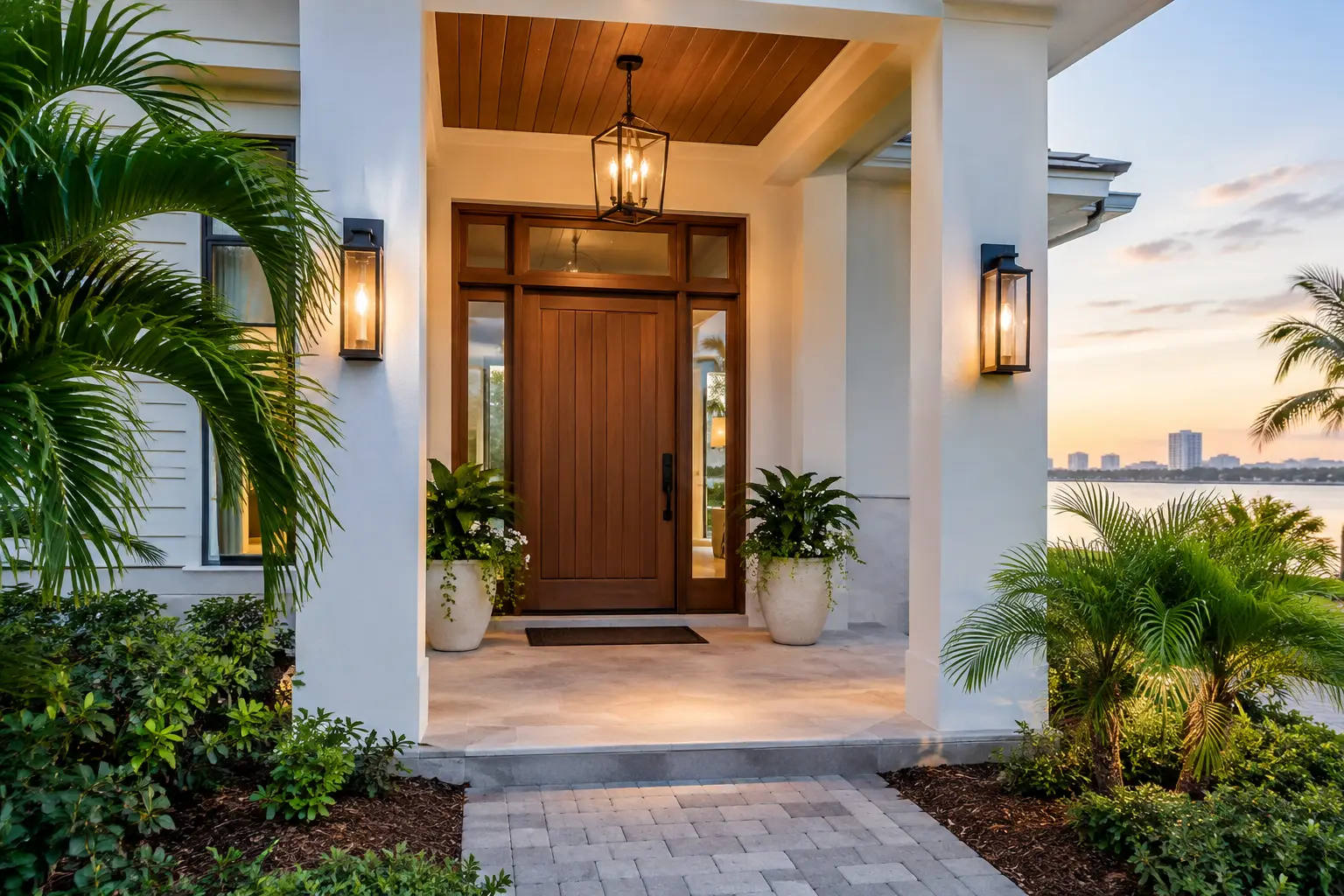
A beautiful front entry should not disappear at sunset. It should become more inviting: a softly defined walk, an illuminated house number, a front door with presence, and enough light underfoot for guests to arrive confidently. This entryway lighting guide explains how Tampa Bay homeowners can create that balance without turning the front of the home into a row of bright fixtures.
The best entry lighting feels intentional rather than obvious. It supports safety and visibility, but it also gives architecture, landscaping, and the approach to your home a sense of depth. The result is a stronger first impression from the street and a more welcoming experience every time you come home after dark.
Begin With the Arrival Experience
Entryway lighting is more than a porch fixture. Consider the sequence a visitor experiences: pulling into the driveway, seeing the home from the street, walking the path, finding the front door, and stepping inside. Each moment calls for light, but not necessarily the same type or intensity of light.
A single bright lantern over the door may technically light the lock, yet it can leave the pathway dim and the façade flat. Conversely, an elaborate landscape lighting system can look impressive from the curb while still failing to clearly define the steps leading to the entrance. A tailored plan connects these zones so the eye naturally moves toward the door.
For larger Tampa Bay properties, that approach often begins farther from the front porch. A subtly illuminated drive, specimen palm, oak canopy, or low planting bed can establish arrival long before guests reach the entry. Closer to the home, the lighting should become more focused, guiding rather than competing for attention.
Entryway Lighting Guide: Build in Layers
A refined exterior lighting design uses layers. Every fixture should have a purpose, whether it is improving safe passage, revealing architectural character, or creating ambient warmth.
Define the Front Door
The front door is the visual destination, so it deserves the most deliberate treatment. Wall-mounted lanterns, pendant fixtures under a covered portico, or a carefully selected overhead fixture can provide practical illumination for keys, packages, and visitors. The scale matters as much as the style.
Fixtures that are too small can feel lost against a tall door, wide columns, or a two-story entry. Fixtures that are oversized or excessively bright can overwhelm the door and cast harsh shadows across faces. On a more formal façade, paired fixtures on either side of the door often create balanced symmetry. A compact entry may benefit from one substantial, well-proportioned fixture instead.
Choose a finish and silhouette that relate to the home’s architecture. Clean-lined matte black or bronze fixtures can complement contemporary and transitional homes, while lantern-inspired forms suit Mediterranean, coastal, and traditional residences. Matching every outdoor fixture exactly is not required. A coordinated family of finishes and shapes usually looks more considered than a forced match.
Light the Walk, Steps, and Changes in Grade
Safety is one of the most valuable benefits of entry lighting, particularly where pavers, steps, uneven transitions, or wet surfaces are part of the approach. Path lights should reveal the walking surface and its edges without producing a runway effect.
Spacing is key. Placing fixtures directly opposite each other creates a formal look, but it can feel rigid on a winding garden walk. Alternating fixtures from side to side tends to create a more natural rhythm while still defining the route. The goal is overlapping pools of soft light, not isolated bright circles separated by darkness.
Steps deserve their own attention. Downlighting from a nearby wall, railing, soffit, or tree can show the tread and riser more gracefully than a bright fixture pointed straight at the stairs. Where suitable, recessed step lights offer a crisp architectural detail. Their placement and beam direction should prevent glare for someone walking upward toward the home.
Add Architectural Depth
Architectural lighting gives an entryway its nighttime identity. Gentle uplighting on columns, textured stone, a front gable, or a distinctive arch can bring dimension to areas that would otherwise recede into darkness. Used with restraint, it makes the home appear composed and welcoming from the street.
The trade-off is simple: more fixtures do not automatically create more elegance. Lighting every column, roofline, shrub, and wall can flatten the architecture and make a luxury property feel overdone. Select the details that make your home distinctive, then allow areas of shadow to frame them.
For example, a home with dramatic stucco arches may need only a few narrow, controlled beams to reveal its texture. A modern home with broad planes may look stronger with subtle grazing light along a feature wall and a clean wash across the entry. Mature landscaping can soften those architectural effects when illuminated at lower levels.
Use Landscape Lighting to Frame, Not Hide, the Entry
Plantings near the front walk should support the entry rather than obscure it. Uplighting a palm, ornamental tree, or sculptural hedge can add vertical interest and guide the eye toward the house. Small accent lights can reveal layers of foliage and create an inviting transition from the landscape to the porch.
Be selective around windows and bedrooms. A fixture positioned too close to the house, or aimed without careful shielding, can create distracting glare indoors. Professional-grade fixtures with adjustable optics and glare control offer greater precision than broad, unfocused beams.
Tampa Bay’s lush landscapes change quickly. Trees grow, palms are trimmed, and seasonal plantings come and go. A lighting plan should allow for those changes, with fixture locations that can be adjusted as the property matures.
Choose Warm, Comfortable Light
For most upscale residential entries, warm white LED lighting creates the most timeless effect. A color temperature around 2700K generally feels inviting and works beautifully with warm stone, brick, stucco, and traditional architectural finishes. Around 3000K can offer a slightly cleaner appearance for contemporary materials and cooler exterior color palettes.
Very cool white light often appears stark against residential architecture and can make greenery look unnatural. It may provide a sense of brightness, but brightness alone is not the goal. Color temperature should enhance the materials of the home and make guests look comfortable at the door.
Quality LEDs are especially well suited to Florida properties because they offer low energy use, long service life, and consistent output. Still, fixture construction matters. Outdoor lights must withstand humidity, heavy rain, irrigation, salt exposure in coastal areas, heat, and occasional storm conditions. Weatherproof materials, durable finishes, sealed connections, and correct installation protect both the appearance and performance of the system.
Control Glare Before It Controls the Design
Glare is one of the fastest ways to undermine an otherwise attractive entryway. It happens when a bulb is exposed, a beam is aimed into a visitor’s line of sight, or a fixture produces more light than the space needs. A bright source can make the surrounding area seem darker because the eyes adjust to the strongest point of light.
Shielded fixtures, frosted lenses where appropriate, careful aiming, and lower-output lamps often produce a better result than simply increasing wattage. The most successful entry lighting lets people see the home, the path, and one another without noticing uncomfortable brightness.
This is particularly relevant for front doors with glass inserts, reflective pavers, polished stone, or light-colored stucco. These surfaces can bounce light back toward the approach. During a nighttime design review, small adjustments in fixture angle and output can make a dramatic difference.
Plan for Convenience and Long-Term Performance
Your lighting should look polished whether you are hosting guests, returning from dinner, or away for the weekend. Astronomical timers can automatically follow changing sunset times, while smart controls can add scheduling flexibility for certain zones. A separate setting for pathway and entry lights may allow those essentials to remain on while accent lighting follows a different schedule.
Maintenance should also be part of the decision, not an afterthought. Even premium systems need periodic attention. Fixtures may shift as soil settles, lenses collect debris, plants grow into beam paths, and coastal air affects finishes over time. Regular service preserves the original nighttime effect and catches small issues before they become visible gaps in the design.
Elegant Accents Outdoor Lighting approaches entryway design as part of the complete property, considering the view from the street, driveway, walkway, porch, and interior rooms. A professional consultation helps clarify fixture scale, light levels, control options, and the most effective way to invest in the features that will make the greatest visual difference.
A front entry does not need to be bright to be memorable. It needs to feel clear, gracious, and unmistakably connected to the home around it. When the path is easy to follow and the architecture is revealed with restraint, the welcome begins well before the door opens.