
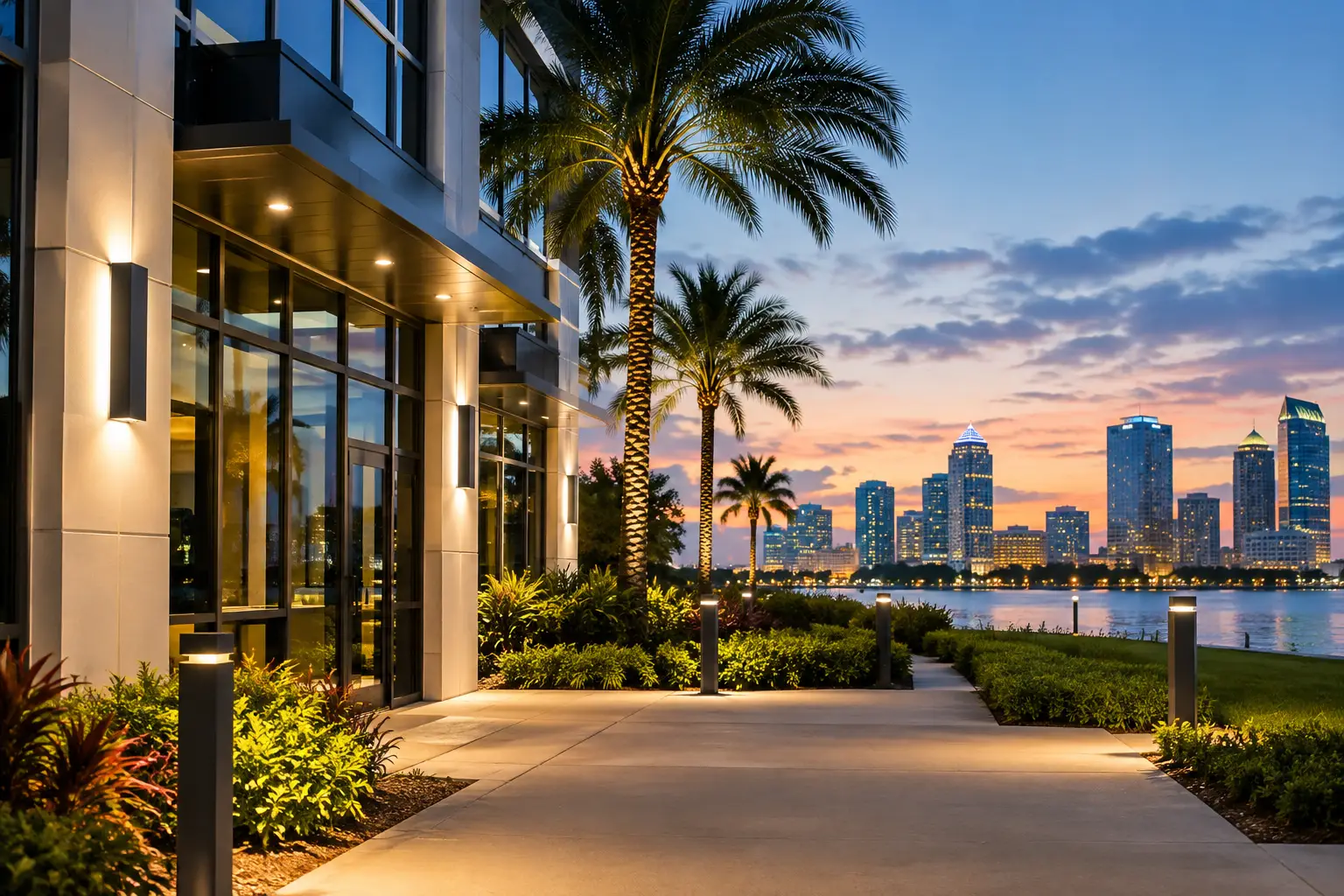
A restaurant patio can feel inviting at sunset and disappear by 9 p.m. A medical office may have excellent daytime signage but leave patients uncertain about where to park after an appointment. A thoughtful commercial exterior lighting guide begins with these real after-dark moments: how people arrive, move through the property, recognize the business, and feel once they are there.
For Tampa Bay commercial properties, exterior lighting is not simply a security feature or a row of bright fixtures mounted to a wall. It is a visible extension of the business. The right plan gives architecture greater definition, makes pathways easier to navigate, supports outdoor dining and gathering, and presents the property with a sense of care long after daylight fades.
Begin With the Experience You Want to Create
Every commercial lighting plan should start with the property’s purpose. A boutique hotel, restaurant, professional office, retail center, and waterfront venue all need safe circulation, but their desired mood and operating hours are different. Treating them the same usually produces lighting that is either too flat, too harsh, or too dim where it matters most.
A restaurant may need warm, layered illumination that encourages guests to linger outdoors while keeping entries, steps, and service paths clearly visible. A medical or professional office typically benefits from a composed, reliable appearance that helps visitors feel comfortable arriving for an early appointment or leaving after dark. Retail properties need strong visual cues at entrances and storefronts without creating glare that makes signage harder to read.
Before fixture styles are selected, consider who uses the space, when they use it, and what they need to see. A property that welcomes guests after sunset has different priorities than one used primarily by employees. A site with mature palms, a dramatic façade, or a central courtyard has opportunities that a basic floodlight plan will miss.
Commercial Exterior Lighting Guide: Build in Layers
Exceptional outdoor lighting is layered. Rather than relying on one intense source to illuminate an entire property, a tailored design assigns each fixture a clear job. The result is more attractive, more comfortable for visitors, and often more efficient.
Start With Arrival and Wayfinding
The arrival sequence sets the tone. Parking areas, driveway entrances, drop-off zones, walkways, ramps, stairways, and primary doors should be easy to identify at a glance. This is where practical illumination deserves priority.
Even coverage matters more than sheer brightness. Deep pockets of darkness beside overly bright fixtures can make a property feel less secure, not more. Carefully positioned area lights, path lights, bollards, and downlights can guide people naturally from their vehicle to the entrance while reducing uncomfortable glare.
Pay close attention to transitions. A guest leaving a well-lit parking area and entering a dark walkway needs time for their eyes to adjust. Gradual changes in light level create a more comfortable and safer experience.
Define Architecture Without Washing It Out
Architectural lighting gives commercial buildings a recognizable evening identity. It can reveal stonework, columns, rooflines, porte cocheres, entry arches, textured walls, and distinctive landscape features that are invisible after sunset.
The goal is definition, not blanket brightness. Uplighting may add drama to a façade or specimen palm, while grazing can bring out the character of textured materials. Soft downlighting can provide usable light near an entry without filling the area with exposed glare. The best composition leaves intentional areas of shadow, allowing illuminated details to stand out.
Color temperature also shapes the impression. Warmer LED light often complements hospitality settings, natural stone, and refined landscape design. Neutral white may suit a more contemporary office or retail environment. The proper choice depends on exterior finishes, brand personality, and the atmosphere the business wants to create.
Support Outdoor Amenities and Revenue Spaces
For restaurants, hotels, clubs, and venues, outdoor areas can be valuable operating space. Patios, pool decks, courtyards, cabanas, docks, and event lawns need lighting that supports conversation and movement without making guests feel as though they are seated beneath a parking-lot fixture.
Low-level path lighting, discreet tree-mounted downlights, architectural accents, and dimmable decorative elements can create an elegant setting while preserving visibility. In these spaces, fixture placement matters as much as output. Light should land on tables, paths, thresholds, and gathering zones, not in guests’ eyes.
Choose Fixtures for Florida Conditions
Tampa Bay’s heat, humidity, salt air in coastal areas, heavy rain, and seasonal storms place real demands on exterior systems. A fixture that looks appealing in a catalog but lacks weather-resistant construction can corrode, discolor, or fail prematurely.
Commercial properties benefit from professional-grade LED fixtures with durable finishes, sealed components, and installation methods suited to the site. Coastal and waterfront locations require especially careful material selection. The same applies to docks, pool decks, and irrigation-heavy landscapes, where moisture exposure is constant.
LED technology is the practical standard for most commercial applications because it reduces energy consumption, offers long service life, and provides excellent control over beam spread and color temperature. Still, LEDs are not all equal. Fixture housing, optics, driver quality, heat management, and serviceability all influence how the system performs over time.
Avoid choosing solely by wattage or the lowest initial price. A less expensive fixture can become the costlier choice if it produces uneven light, requires frequent replacement, or cannot withstand the environment.
Use Controls With Intention
Controls protect the investment and make the property easier to manage. Timers, photocells, astronomical scheduling, dimmers, and zoning allow lighting to respond to business hours and changing needs.
A restaurant, for example, may want entry and parking illumination active through closing while reducing decorative landscape lighting later in the evening. An office complex may schedule a consistent nightly presentation but use occupancy-responsive lighting in less frequently traveled areas. Hospitality properties often need flexibility for private events, seasonal hours, and special occasions.
More control is not always better. An overly complicated system may be ignored or programmed incorrectly. The right approach is one that staff can understand easily, with schedules that reflect how the property actually operates.
Manage Glare, Spill Light, and Neighboring Properties
Brighter is not automatically safer or more attractive. Poorly aimed lighting can create glare for drivers, discomfort for guests, and unwanted light on adjacent homes or businesses. It can also flatten the very architecture and landscaping the system is intended to showcase.
Shielding, beam control, proper mounting height, and thoughtful aiming are essential. A designer should view the property from multiple perspectives: approaching by vehicle, walking the primary paths, sitting on a patio, and looking toward the site from neighboring areas. What appears effective from one location may be distracting from another.
Local requirements and property-specific restrictions may affect fixture placement, mounting heights, controls, and light spill. For waterfront, coastal, or environmentally sensitive sites, additional considerations may apply. A professional site review helps identify these issues before installation rather than after a fixture has been mounted.
Plan for Maintenance From the Start
Commercial exterior lighting is a long-term system, not a one-night reveal. Landscaping grows, storms shift fixtures, lenses collect debris, and changes in operations may call for adjustments. Regular service preserves both performance and presentation.
Maintenance should include checking fixture alignment, cleaning lenses, inspecting wiring and connections, trimming plant material away from light paths, verifying timers and controls, and replacing components before a visible outage affects the property. For businesses that depend on a polished guest experience, preventative care is far less disruptive than waiting for dark zones or failed fixtures to become a complaint.
This is also where a custom design shows its value. A well-planned system is organized into serviceable zones, uses quality components, and can adapt as landscaping and business needs evolve.
What a Professional Lighting Process Should Include
A commercial project deserves more than a quick walk-through and a generic quote. The process should begin with a consultation that considers architecture, landscape, traffic flow, operating hours, safety concerns, and desired ambiance. A clear proposal should explain the design intent, fixture selections, scope of installation, and pricing before work begins.
Installation quality matters just as much as design. Experienced in-house crews can place fixtures accurately, protect existing landscaping and hardscapes, conceal wiring where appropriate, and fine-tune aiming after dark. That final nighttime adjustment is where a lighting plan becomes a finished composition.
Elegant Accents Outdoor Lighting has focused exclusively on outdoor lighting since 1999, bringing this level of design, installation, and ongoing maintenance to commercial properties throughout Tampa Bay.
The most memorable commercial properties do not simply remain visible after sunset. They feel intentional, welcoming, and distinctly their own. Start by walking your site after dark as a first-time visitor would, then let each light earn its place in the experience.