
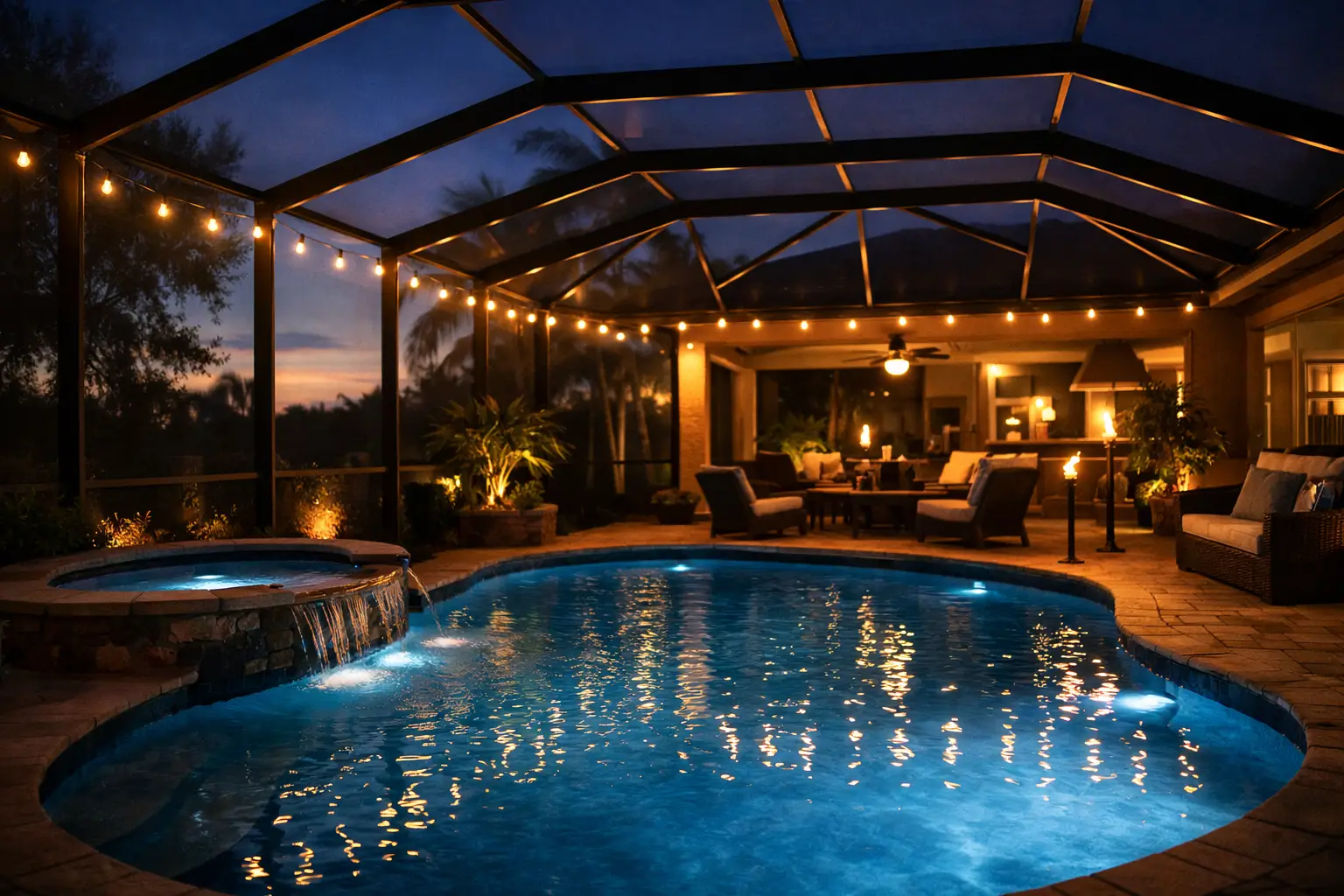
The best lights for pool cage living do more than help guests find their way after sunset. They give a Tampa Bay lanai a finished, resort-like presence, extend the hours you can enjoy the water, and make the enclosure feel intentionally designed rather than simply illuminated. The difference is not usually the number of fixtures. It is thoughtful placement, warm color, controlled brightness, and equipment built to withstand Florida heat, rain, salt air, and humidity.
A pool cage presents a distinctive lighting opportunity. Its frame creates natural lines for discreet illumination, while the screen enclosure can easily reflect glare or reveal every harsh hotspot. A tailored plan considers the pool, deck, dining area, outdoor kitchen, landscape, and views beyond the cage as one complete nighttime setting.
What Makes the Best Lights for Pool Cage Areas?
For most upscale homes, low-voltage LED lighting is the preferred foundation. It delivers excellent light quality with modest energy use, stays cooler than older halogen systems, and gives a professional designer precise control over where light falls. Quality LED fixtures also hold their color and performance longer, which matters in an outdoor environment that sees daily exposure to moisture and intense sun.
The fixture itself must be suited to the location. Pool cages are not protected indoor rooms. Look for wet-location-rated fixtures, corrosion-resistant finishes, sealed connections, and components designed for coastal or humid conditions. Tampa Bay homes near the water need particular attention to materials and maintenance, since salt exposure can shorten the life of poorly specified hardware.
Just as important, the light should be comfortable. The goal is enough illumination for circulation, seating, and entertaining without turning the lanai into a bright, flat space. Warm white light, typically in the 2700K to 3000K range, tends to flatter stone, pavers, landscaping, and architectural finishes. Cooler white light may feel sharper and more utilitarian, especially when it reflects off a pool surface or screen panels.
Start With How You Use the Space
The right system depends on what happens around the pool after dark. A family that swims most evenings needs safe, even visibility around steps, deck transitions, and gates. A homeowner who hosts dinner parties may value subtle lighting around a dining table and outdoor kitchen, with the pool serving as a calm visual centerpiece. If the cage frames a preserve, golf course, or waterfront view, restraint becomes even more valuable.
This is why a single bright fixture at the center of the enclosure rarely produces an elegant result. It may light the space, but it can create glare, deep shadows, and an unflattering view of the cage structure. Layered lighting creates more refinement: one layer for safety, one for atmosphere, and one for architectural definition.
A professional lighting plan also accounts for what should remain dark. Preserving a shadowed edge near a view, avoiding direct light into a neighbor’s yard, and limiting brightness near the water can make the entire space feel more private and composed.
The Most Effective Fixture Types
Downlights for broad, natural illumination
Discreet LED downlights mounted to appropriate cage beams can provide a soft wash across the deck, seating zones, and walkways. When carefully aimed, they mimic the comfortable direction of indoor lighting while keeping the source out of the primary sightline. They work especially well over lounge areas, dining tables, conversation seating, and circulation paths.
Placement matters more than fixture count. A downlight aimed toward an open deck area gives useful light without drawing attention to itself. One aimed directly at a screen panel, glossy tabletop, or the water’s surface can create distracting reflection. The best installations use shielding, aiming, and spacing to make the illumination feel almost effortless.
Accent lights for the cage frame and architecture
The pool cage can become part of the composition rather than a dark outline around the patio. Small, carefully placed accents can reveal a dramatic beam, a vaulted roofline, or an architectural transition between the home and the lanai. This approach is particularly effective on larger enclosures where the cage structure has strong geometry.
Accent lighting should be selective. Lighting every upright and crossbar often feels busy and overdone. Highlighting a few defining lines, paired with illumination on the home itself, creates far more distinction.
Step, wall, and pathway lights for safety
Changes in elevation deserve dedicated lighting. Low-profile step lights, wall lights, or path lights at the transition from the house to the pool deck help guests move confidently without flooding the entire area with light. They are also valuable near a side gate, equipment access route, or dock connection.
These fixtures are functional, but they do not need to look functional. Well-integrated step and wall lighting can add a quiet architectural detail during the day and a polished layer of guidance at night.
Landscape and water-edge lighting beyond the screen
Some of the most memorable pool cage lighting is not mounted inside the cage at all. Uplighting palms, ornamental trees, textured walls, or a specimen plant just beyond the enclosure adds depth to the view. A softly illuminated landscape backdrop makes the pool area feel larger and more connected to the property.
Pool and spa lighting also deserve consideration within the overall scene. The water should glow, not compete with every other element. If existing pool lights are bright blue or change colors frequently, a warm, restrained cage and landscape plan can provide balance. For a more classic look, homeowners often choose a calm white water light and warm architectural lighting around it.
Avoid the Common Pool Cage Lighting Mistakes
The fastest way to diminish a beautiful lanai is with exposed bulbs, mismatched color temperatures, or fixtures installed without a plan. String lights may be appropriate for a temporary celebration, but they rarely provide the durability, clean appearance, or dependable coverage expected of a permanent luxury outdoor space.
Overlighting is another frequent mistake. More lumens do not automatically mean more usable light. Excess brightness can cause glare on wet pavers, interfere with nighttime views, attract insects, and make a pool enclosure feel less relaxing. It can also expose every screen seam and structural detail that is better left in the background.
Avoid relying on solar fixtures for primary pool cage lighting. They may be convenient in a small garden, but their output and run time are inconsistent, especially during summer storms or periods of heavy cloud cover. A wired low-voltage system offers stronger performance, cleaner integration, and more reliable control.
Finally, do not treat installation as an afterthought. Pool cages involve aluminum structures, screens, electrical routing, water proximity, and local code considerations. Improper drilling, unsecured wiring, or poorly sealed connections can lead to damage and premature failure. A qualified outdoor lighting specialist can coordinate the design with the enclosure and pool environment rather than forcing fixtures into unsuitable locations.
Control Is Part of the Experience
The finest lighting plans are simple to use. Separate zones let you set a gentle everyday scene, brighter illumination for entertaining, and focused safety lighting when the pool is active. Timers, photocells, and smart controls can automate the routine while allowing adjustments from a wall control or mobile device, depending on the system.
Dimming is worth discussing during the design phase. It gives homeowners the flexibility to create a brighter setting for a family gathering, then lower the light for a quiet evening outdoors. Not every fixture and driver combination dims equally well, so the system should be specified as a complete package from the beginning.
Maintenance also protects the investment. Screens collect debris, landscaping grows into sightlines, and Florida weather tests every outdoor connection. Periodic service keeps fixtures clean, aiming correct, lamps performing consistently, and the nighttime effect true to the original design.
A Designed Nighttime Reveal
An exceptional pool cage lighting project begins with an evening perspective, not a fixture catalog. During a property consultation, the strongest questions are practical: Where do people walk? Which areas need privacy? What view should be enhanced? Where does glare currently interrupt the experience? Those answers shape a custom plan, a clear proposal, and an installation that respects the architecture of the home.
Since 1999, Elegant Accents Outdoor Lighting has approached Tampa Bay properties with that level of care, using professional in-house crews and weather-ready LED systems designed for lasting performance. The result should feel tailored to the home, not borrowed from a showroom display.
When the right lights are in place, the pool cage stops being the boundary of your outdoor living area. It becomes the graceful frame for evenings that feel safer, more beautiful, and distinctly your own.