
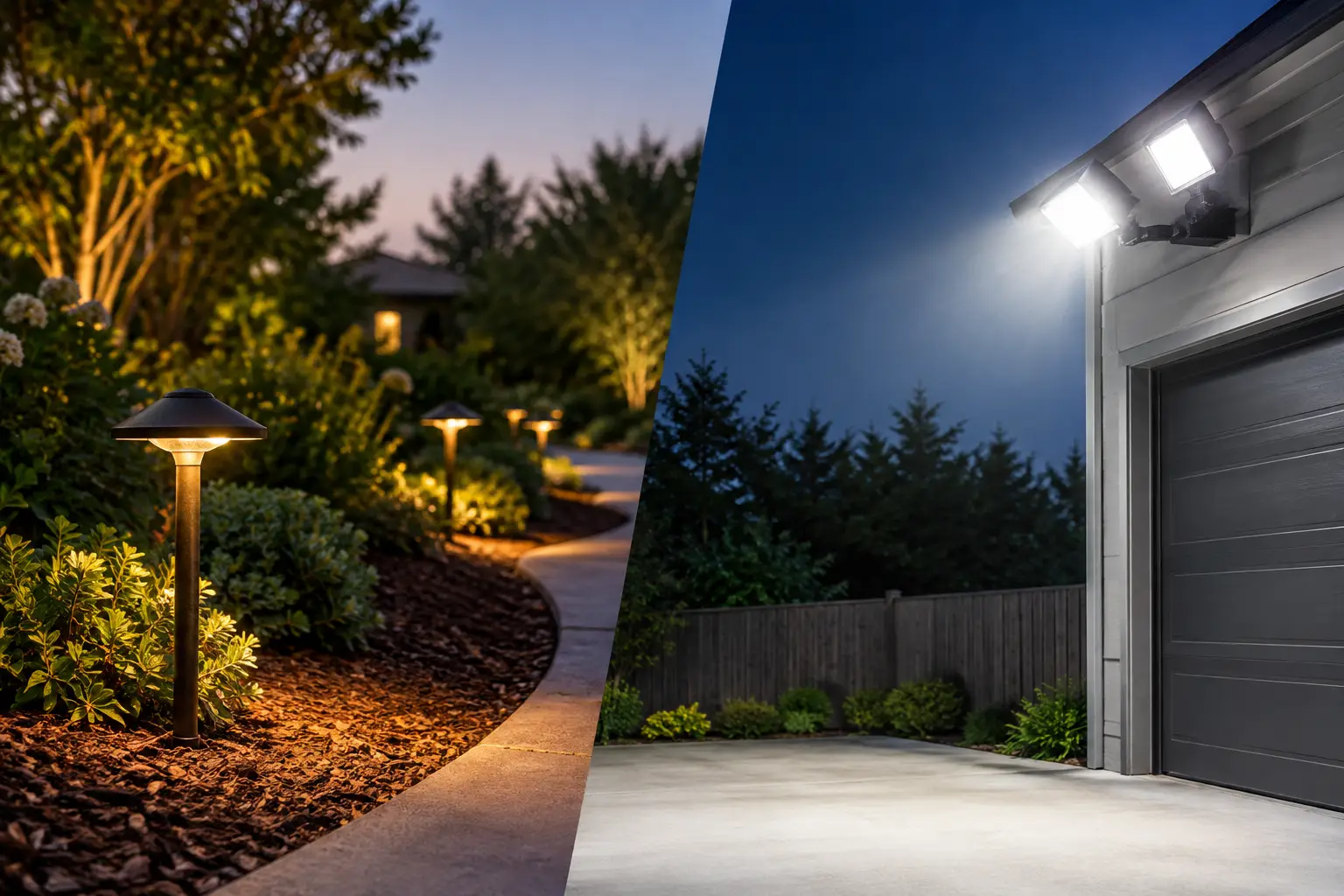
A beautifully designed home can disappear after sunset when its exterior lighting relies on one intense source of brightness. The choice between landscape lighting versus floodlights is not simply a technical one. It determines whether your property feels inviting and refined at night or merely illuminated. For Tampa Bay homeowners, the most successful approach usually begins with understanding what each lighting style is designed to do.
Floodlights have a legitimate role in exterior lighting, particularly where wide-area visibility and practical security are priorities. Landscape lighting, however, is built around a more considered objective: revealing architecture, gardens, pathways, outdoor living spaces, and focal points with depth and restraint. The distinction matters when your home is an investment you want to enjoy long after daylight fades.
Landscape Lighting Versus Floodlights: The Core Difference
Floodlights cast a broad, powerful beam across a large area. They are commonly installed near garages, side yards, driveways, gates, or the rear of a home. Their purpose is direct and functional – to make a dark area visibly bright, often with the added benefit of deterring unwanted activity.
Landscape lighting uses several fixture types and beam spreads to create layers of light. Rather than washing the entire property in brightness, it selectively highlights what deserves attention: the texture of a stone façade, the canopy of a mature oak, an elegant palm, a garden wall, a fountain, or the edge of a walkway. The result is a composed nighttime view that feels as intentional as the landscape itself.
The difference is similar to the difference between overhead room lighting and a thoughtfully furnished interior with lamps, accent lights, and dimmers. One lets you see. The other creates an experience.
Where Floodlights Make Sense
A quality floodlight is not automatically harsh or unattractive. In the right location, it provides practical coverage that other fixtures cannot always deliver efficiently. A dark service yard, a broad driveway, a boat or equipment storage area, or a gated side entrance may benefit from a controlled flood beam.
Motion-activated floodlights can also be useful in locations where light is only needed occasionally. This keeps the area dark under normal conditions while providing immediate visibility when someone approaches. For homeowners who travel frequently or have limited sightlines around the property, that added awareness can be reassuring.
Still, floodlights require careful placement. A fixture installed too high, aimed too low, or specified with more output than the setting requires can create uncomfortable glare. It may shine into bedroom windows, spill toward a neighbor’s property, flatten the home’s exterior details, or create deep shadows just beyond the beam. More light does not always create more security. Even, purposeful illumination often does a better job of reducing hiding places and helping cameras capture useful images.
Why Landscape Lighting Creates More Lasting Appeal
Landscape lighting gives a property visual hierarchy. It guides the eye from the street to the front entry, across the façade, and into the layers of planting that frame the home. It can make a modest architectural feature feel distinctive and help a significant property look complete after dark.
Uplighting is often used to bring dimension to trees, columns, textured walls, and rooflines. Downlighting from a tree or structure can create gentle, moonlit coverage over a lawn, terrace, or pathway. Path and area lights define circulation without turning a walk to the front door into a runway. Under-cap, step, and rail lighting can make a deck, pool cage, or dock safer while preserving a relaxed evening atmosphere.
This layered method also improves comfort outdoors. A pool deck or lanai does not need the intensity of a parking area. It needs enough illumination to move confidently, dine comfortably, and enjoy conversation without feeling exposed under a glaring fixture. Warm, carefully aimed LED lighting can make these spaces feel more inviting while helping guests see changes in elevation, doorways, and seating areas.
For a Tampa Bay property, landscape lighting also brings year-round value. Outdoor entertaining is not limited to a short season here. Whether the setting is a waterfront deck, a screened pool enclosure, a courtyard, or a front garden with tropical plantings, professional lighting extends the hours when those spaces can be used and appreciated.
Security Without Sacrificing Sophistication
Many homeowners assume floodlights are the only serious security option. In practice, a layered landscape lighting system can support security in ways that feel more discreet and more elegant.
A well-lit arrival path, driveway edge, entry, side gate, and rear transition area eliminate abrupt pockets of darkness around frequently used parts of the property. Architectural lighting makes the perimeter easier to observe from inside the home and gives the appearance that the property is actively cared for. Timers, photocells, and smart controls can ensure the system operates consistently, even when no one is home.
Floodlights may still be added where they are most effective – such as a concealed side yard or a larger rear boundary – but they do not need to dominate the lighting plan. The best designs treat security and beauty as complementary goals, not competing ones.
Consider Beam Control, Color, and Glare
The quality of exterior lighting is shaped by far more than fixture brightness. Beam width determines whether light reaches a single palm trunk, a wide oak canopy, or a broad wall. Color temperature influences how the property feels. Warmer tones are generally more flattering to natural stone, stucco, wood, landscaping, and outdoor gathering spaces, while excessively cool light can make a home feel sterile.
Glare control is equally important. The light source should rarely be the first thing you notice. Professional-grade fixtures use proper shielding, aiming, and placement to direct illumination onto the feature or surface that needs it. This is particularly valuable near waterfront properties, pool decks, and neighborhoods where a poorly aimed fixture can affect nearby homes.
Durability also deserves attention in Florida’s heat, humidity, rain, and coastal air. Weatherproof LED fixtures, sound electrical connections, and components selected for the environment help protect both the appearance and long-term performance of the system. A lower-priced fixture can look acceptable on installation day yet fade, corrode, shift, or fail sooner than expected.
A Better Way to Plan Your Property
The right decision is rarely landscape lighting or floodlights. It is usually a balanced plan that gives each fixture a specific assignment. Floodlights can provide targeted coverage where broad visibility is necessary. Landscape lighting can shape the overall impression, provide comfortable wayfinding, and emphasize the craftsmanship already built into your home.
A thoughtful design begins at the street, where curb appeal and architectural definition matter most. It then follows the natural way you use the property: arriving at the driveway, walking to the entry, moving through side gates, relaxing on the lanai, or gathering around the pool. Features that are meaningful in daylight should be considered for nighttime emphasis, but not every tree, wall, or planting bed needs a fixture. Restraint is what gives a lighting design its timeless elegance.
At Elegant Accents Outdoor Lighting, that process is guided by a property consultation, a custom plan, and a transparent proposal before installation begins. The nighttime reveal should feel like a transformation, but it should also make practical sense fixture by fixture. Professional installation and ongoing maintenance protect that result through changing seasons and years of use.
The Investment Beyond Brightness
A floodlight is often a quick answer to darkness. A complete landscape lighting design is an investment in how a property performs and feels at night. It supports safer movement, enhances curb appeal, creates a stronger setting for entertaining, and brings visual definition to the details that make a home unique.
If there is one principle worth carrying into the decision, it is this: choose light for the purpose of the space, not simply for the amount of darkness. When every beam has a reason to be there, your home can feel secure, welcoming, and unmistakably distinguished after sunset.